14.4.06
Interfaces que dão e recebem conselhos!
Henry Lieberman do MIT é o autor de Interfaces That Give and Take Advice. Sobre os interfaces que possuem um sistema de aconselhamento ou sugestão, temos o exemplo da Amazon.com e ainda o Pandora.com, que por sua vez se dedica a recolher informações dos utilizadores sobre os seus gostos musicais, informação essa que pode ser aplicada em sistemas como o da Amazon na venda/sugestão de música online.


13.4.06
Folksonomy
Thomas Vander Wal cunhou o termo "folksonomy" em 2004, agora explica-nos a diferença entre a Banda estreita e a Banda Larga em folksonomies, no seu blog em vanderwal.net. Como exemplos entre os dos dois tipos de folksonomias (perdoem-me a tradução livre!), o autor dá o del.icio.us como banda larga e o Flickr para o segundo caso.
6.4.06
The new blogocracy
Danah Boyd, de quem já aqui falei, é autora de um artigo sobre a presença de bloggers na convenção do partido democrático, e o buzz gerado nos mass media.
"As a practice, journalism espouses an air of objectivity, purporting to cover all sides of a debate, equally and with emotional distance. While few believe that journalists are unbiased, it is considered a respectable aim of the profession and readers expect them to be as objective as possible. Bloggers, on the other hand, have no such cultural code and their readers rarely hold them accountable for objectivity. In fact, what makes blogging confusing for many is that the practices encompassed by that term are quite diverse."
"Bloggers at the Democratic National Convention signify a shift in media, but not a replacement for mainstream coverage. Their role will be to fill in the gaps, expose the underlying magic, and keep everyone on their toes. What they are doing cannot be compared to journalism; it can only be described as blogging."
G/localization: When Global Information and Local Interaction Collide
A construção de comunidades online tem vindo a ser cada vez mais importante para as empresas que querem ter uma presença forte na Internet. Danah Boyd fez uma apresentação muito boa sobre este assunto, e o texto está disponível no seu site.
"Designers who work with networks must face these tensions and design to take advantage of the global while not destroying the local. This is a hefty challenge and one that i want us to dive into."
"The digital era has allowed us to cross space and time(...)Yet, people don't live in a global world - they are more concerned with the cultures in which they participate."
"Today, we are trying to build a whole new level of social communities. Some folks are building more open social platforms so that participants can modify the structures to meet their own needs."
Danah Boyd apresenta Craigslist, Flickr e MySpace como exemplo de comunidades que cresceram organicamente:
"They all grew organically. They each have public personalities that early adopters feel connected to. The early adopters really felt as though they were participating in and creating an intimate community, even as the community grew to millions. Users are passionate. Designers are passionate."
5.4.06


João Garcia Bloga
A iniciativa é boa, e outros aventureiros portugueses já o fizeram anteriormente. O alpinista João Garcia tem um blog na siconline, mas até agora os posts são da autoria do jornalista Aurélio Faria. Seria interessante ter o João na primeira pessoa, senão para quê um Blog!?...

Novo livro lançado no Abrupto
Saludo desde já a iniciativa de Agustina Bessa Luis, em fazer um pré-lançamento do seu novo livro no Blog Abrupto, de Pacheco Pereira.
31.3.06
Tagging
O tagging vem sendo cada vez mais utilizado como forma de classificação de conteúdos. Estes por sua vez deixam de respeitar uma hierarquia rígida, e passam a reflectir a forma como nós, humanos, "arrumamos" a informação na nossa mente. Se esta tendência continuar prevejo alguns dos profissionais da Arquitectura de Informação (AI) a perder os seus empregos, pois eles tratam exactamente de hierarquizar a informação.
No artigo sobre esta matéria também na MIT Technology Review, podemos ler (texto a bold inserido por mim):
"Without Google, Yahoo, and their brethren, using the Web would be like wandering through a library where a prankster has restacked the books at random..."
"Imagine instead being able to call on the group judgment of other users, people who are constantly skimming the latest Web content and arranging the best stuff into neatly labeled piles."
"It's called tagging, and it's going on at a handful of free websites--Delicious, Flickr, Furl, and Rojo, among others--where members are voluntarily classifying and categorizing thousands of pieces of content each day."
"...there's a twist that makes tagging a collectivist undertaking: everybody can see everybody else's tags."
"There's no uniformity to the way people tag Web pages, so the same tag might wind up being applied to very different kinds of content. But to most developers, that's actually a strength of the technology, not a weakness."
O Tag e o RSS serão, para já, duas tecnologias que têm ajudado a revolucionar os serviços electrónicos, com a vantagem de serem duas soluções muito simples do ponto de vista tecnológico.
As maravilhas do "photo sharing"
o BubbleShare é um novo rival do Flickr, e pelos vistos possui argumentos de peso para enfrentar o gigante da Yahoo, no armazenamento e partilha de fotos entre utilizadores, uma das novidades é o BubbleBar, descrito no artigo do MIT Technology Review
"The BubbleBar pulls images from your online BubbleShare albums and sends a parade of thumbnails down the side of your computer's desktop, like a filmstrip; placing your mouse over one of the thumbnails pulls up a larger version, along with captions and comments. But that's not all. The BubbleBar also watches for new albums published on BubbleShare by your acquaintances and downloads them automatically. So, if your photographer friends are sufficiently prolific, you can wake up to a new set of images every day, without lifting a finger."
"The BubbleBar pulls images from your online BubbleShare albums and sends a parade of thumbnails down the side of your computer's desktop, like a filmstrip; placing your mouse over one of the thumbnails pulls up a larger version, along with captions and comments. But that's not all. The BubbleBar also watches for new albums published on BubbleShare by your acquaintances and downloads them automatically. So, if your photographer friends are sufficiently prolific, you can wake up to a new set of images every day, without lifting a finger."
30.3.06
Wikipedia: Smart Mob
"The smart mob is a concept introduced by Howard Rheingold in his book Smart Mobs: The Next Social Revolution. According to Rheingold, smart mobs are an indication of the evolving communication technologies that will empower the people."
"A smart mob is a group that, contrary to the usual connotations of a mob, behaves intelligently or efficiently because of its exponentially increasing network links. This network enables people to connect to information and others, allowing a form of social coordination."
"...the smart mob is a practical implementation of collective intelligence. According to Rheingold, examples of smart mobs are the street protests organized by the anti-globalization movement."
Wikipedia: Collective Intelligence
"...is a working form of intelligence which overcomes "groupthink" and individual cognitive bias in order to allow a collective to cooperate on one process—while maintaining reliable intellectual performance. In this context, it refers to robust consensus decision making, and may properly be considered a subfield of sociology"
"the capacity of a human community to evolve toward higher order complexity thought, problem-solving and integration through collaboration and innovation."
"the capacity of a human community to evolve toward higher order complexity thought, problem-solving and integration through collaboration and innovation."
Online Collaboration: What Are The Key Traits Of Ideal Online Collaborators?
Mais um excelente texto em Kolabora.com com o título Online Collaboration: What Are The Key Traits Of Ideal Online Collaborators?
"In reality, through the survey they have found out that trained, facilitated teams achieve more creative breakthroughs, faster, and are more likely to achieve extraordinary results, accomplishing things as a team that the individuals working individually could never have achieved."
"Collaboration can be hard work, since it requires us to think outside our 'frames' and see things from others' perspectives."
"To some extent that is the message that this survey gives us: Attitude is most important, and if we believe collaboration will succeed, it will, and if we don't, regardless of our group's skill, experience, and personality, it won't."
Location-based games overview
Se alguém na Ydreams está a ler este post, talvez se interesse por este artigo:
Location-based games overview
Location-based games overview
Information versus Knowledge
Nicolas Nova faz uma recensão de um texto da Harvard Business Review, ao qual não tive acesso, mas que vale a pena reproduzir aqui. Basicamente demonstra a enorme diferença entre Informação e Conhecimento na Web:
“Several technological and political forces have converged, and that has produced a global, Web-enabled playing field that allows for multiple forms of collaboration without regard to geography or distance – or, soon, even language.”
"What’s the difference between information and knowledge? Information is a message, one-dimensional and bounded by its form: a document, an image, a speech, a genome, a recipe, a symphony score"
"Knowledge results from the assimilation and connecting of information through experience, most often through apprenticeship or mentoring."
"...global conversation is essential to achieving true democratization of knowledge. But simply giving everyone access to e-mail and Google will never in itself flatten the earth."
Are bloggers authoritative sources at big companies?
Robert Scoble, autor do livro Naked Conversations, coloca uma questão no seu blog: Are bloggers authoritative sources at big companies?
28.3.06
Social Computing
A Technology Review tem também um dossier especial sobre computação social que vale a pena explorar...
The Evolution of IM
O Instant Messaging ainda é, ou cada vez mais, uma óptima ferramenta de colaboração, mas há umas que estão a evoluir mais que outras, segundo o artigo na Technology Review do MIT.
"Ideally, according to Gizmo's Robertson, people should be able to send instant messages or make an Internet phone call as easily as sending an e-mail message. Someone who uses Microsoft's free web-based Hotmail service, for instance, can transparently send messages to Yahoo Mail or Google's Gmail. This inter-operability dates back to the early days of the Internet, when all e-mail servers were designed to use the same protocol, Saint-Andre says.
IM, however, started out as proprietary software and has stayed that way. Robertson wants to change that with initiatives like Gizmo. "The world I'm trying to create is one in which you have one screen name that works everywhere, very similar to e-mail," he says. "That's not the way IM works today. It's a big mess."27.3.06
Visual Complexity
 Para quem gosta de mapas de sistemas complexos, sejam eles de transportes ou de comunicações, entre outros...
Visualcomplexity.com
24.3.06
Digital Media "empowering users"
Num artigo da BBC News, pude ler:
"the customer is king" is fast becoming the industry's new catchphrase.
"People want to connect to information and connect to their friends," he said. "The focus will be on highly personalised experiences."
"Collaborative usage of the internet is rising," said Jimmy Wales, the founder of Wikipedia, a free online encyclopaedia written by thousands of users. This is a social innovation, and not just a technological innovation,"
"...consumers of news from the media were transforming themselves into providers of information."
"Ms Twohill cited a recent quote from News Corporation boss Rupert Murdoch - "We tell you less, you tell us more." - to illustrate how some of the global media were engaging with the potential power of citizen journalism."
23.3.06
The Power Of Open Participatory Media And Why Mass Media Must Be Abandoned
Já com destaque no irrealTV e Ponto Media, este artigo é sem dúvida a não perder para se perceber a revolução em curso nos media tradicionais, com destaque para a falta de democracia do modelo actual de distribuição de media.
"In order to better understand the mass media's inherent lack of democracy, it is useful to imagine a communication system that allows and fosters participation by everyone."
Leia-se também a primeira parte deste artigo: Why Mass Media Are Bad: Weaknesses And Limitations Of Commercial Mainstream Media
22.3.06
Weblogs. Diário de Bordo

Neste momento, estou a ler o Livro de Elisabete Barbosa e António Granado, para já com um bom prefácio de Manuel Pinto que enquadra muito bem o tema em questão, onde afirma:
"...é, sobretudo, a ideia que está na concepção dos blogs que é "revolucionária" e de um alcance indivídual e cívico repleto de potencialidades. Desde logo, porque abre terreno para a democratização do acesso à palavra, ao espaço público, ao enriquecimento da conversação social."
21.3.06
Kolabora.com
Uma excelente fonte para quem se interessa em estudar as novas ferramentas de colaboração online.
17.3.06
Entrevista a Jakob Nielsen
16.3.06
"A Newspaper and Citizen Journalism Reading List"
Um bom ponto de partida para quem, como eu, quer saber um pouco mais sobre Citizen Journalism, é esta lista de livros e artigos online. Da lista destaco We the Media de Dan Gillmor, que já está editado em português.
Link: A Newspaper and Citizen Journalism Reading List
Link: A Newspaper and Citizen Journalism Reading List
6.3.06
1 ano = 162 posts
Só hoje reparei que este Blog comemorou 1 ano no passado mês de Fevereiro!:)
Como sou distraído, venho com alguns dias de atraso assinalar a data. Quem acompanha o HCI-U (secalhar ninguém, :)), deve reparar que ao longo deste último ano abordei questões como a Usabilidade, Human-Computer Interaction, TV, Narratividade, Identidade, Location-Based Services, entre outros.
Por vezes olho para trás, e pergunto-me - Será que estou a construir um capital de conhecimento válido para o meu futuro!? - Bom, fico na dúvida, mas ando sempre a saltitar entre vários temas que me interessam, não consigo evitá-lo!.
Como já devem ter reparado, o nome HCI-U representa Human-Computer Interaction e Usabilidade, respetivamente... Mais tarde alterei o título no topo da página para "Human-Context Interaction / Useful", uma vez que já sentia a necessidade de ter um nome que se adequasse a temas mais variados.
Neste momento estou a preparar a tese num tema que acho fascinante, numa àrea que está a revolucionar a forma como se comunica e se produz informação, que são os Blogs - e outros meios - como ferramentas para aumentar o poder dos cidadãos, nivelar a sociedade horizontalmente, e criar conhecimento! Por outras palavras - Democracia! Espero que gostem.
Até já
BJ
TF1 lança canal para Bloggers
Segundo o jornal Público de hoje, a TF1 francesa prepara um canal, cujo os conteúdos serão programados por bloggers.
"Chama-se le.buzz e é apresentado como o projecto mais inovador da TF1 francesa na àrea da multimédia. Trata-se de canal de televisão realizado por bloggers a partir de conteúdos propostos pelos internautas."
"Chama-se le.buzz e é apresentado como o projecto mais inovador da TF1 francesa na àrea da multimédia. Trata-se de canal de televisão realizado por bloggers a partir de conteúdos propostos pelos internautas."
20.2.06
Web 2.0 - As Listas de Aplicações e Serviços
Este resumo não está disponível.
Clique aqui para ver a mensagem.
15.2.06
Don't potS Thinking About Tomorrow

"How human power is changing our society and business – and what this means for you and your company"
13.2.06
100 anos de Agostinho da Silva
Lembro-me, quando mais novo, ver aquela cara de sábio na TV. Barbas brancas, palavra fácil... e um programa que se chamava "Conversas Vadias" :)... o título do programa não podia ser melhor, agora que conheço um pouco mais da personalidade de Agostinho da Silva.
Tenho que ser honesto e admitir que nunca li nada dele, mas a partir de hoje sinto-me na obrigação de!
Tal como já li José Gil, ou já ouvi Carlos Paredes.
Coloco todos estes sob a mesma "tag"! se é que me faço entender!:
- Agostinho da Silva,
- José Gil,
- Pessoa,
- Eduardo Lourenço
- e Carlos Paredes - para mim Paredes, foi à sua maneira e com a sua arte, um visionário da cultura Portuguesa recente. Mas em vez de utilizar a palavra, utilizava a música.
Uns vivos, outros já não se encontram entre nós, mas estes autores mereciam mais destaque nos planos curriculares do Ministério da Educação e do Ensino Superior.
iTunes U - It all starts with learning...
"Apple shares common goals with education — to advance teaching, learning, and research through innovation, and engage and empower students. Students expect a campus environment that accommodates their digital lifestyle, adapts to their individual learning needs, and encourages collaboration and teamwork. Introducing a way to simplify and meet all these needs — iTunes U."

7.2.06
Pandora
Atrvés do podcast do Há Vida Em Markl, do Nuno Markl, aqui fica um projecto muito interessante feito sobre música. Basta seleccionar uma música e o sistema dá-nos uma rádio virtual com uma série de outras músicas com o mesmo "ADN".
Este projecto interessa-me porque é um bom exemplo de um sistema "human centered", o qual se adapta conforme as escolhas dos utilizadores.
Obrigado Markl
Este projecto interessa-me porque é um bom exemplo de um sistema "human centered", o qual se adapta conforme as escolhas dos utilizadores.
Obrigado Markl
31.12.05
Links Design de Informação/Visualização Social
Visual Complexity
Information Aesthetics
Chaomei Chen
Envisioning a Path to the Future
Iraq War Fatalities
Treemaps History
Treemaps Comparison
InformationDesign.org
Info Vis
Ben Shneiderman
Edward Tufte
Mobile Info Vis
LBS-MoSoSo
MoSoSo
Social Software Weblog
Social Fabric
Marumushi
MIT Sociable Media Group
Judith S. Donath
Links Eventos/Conferências
Hypertext 2007
Games 2006 - Portalegre
SHIFT - Social and Human Ideas for Technology
BARCAMP - Portugal
Towards Electronic Democracy
Collaborative Technologies Conference
We Media 2006
Reboot 8
PDC 2006
Games@iulm
Content2.0 2006
O'Reilly Emerging Technology
HigherEd BlogCon
Perform the Media
Don't Stop thinking about tomorrow
3º Encontro Nacional sobre Weblogs
MIT Communications Forum
Mobile HCI 06
ACM SIGCHI ACE 2006
NordiCHI 2006
Future Marketing Awards
HRI 2006
IHM 2005
Pervasive 2006
Open Plan
LOCA 2006
AIGA design conference
designEDGE
IFA
ExperimentaDesign2005
may you live in interesting times
Tactile Graphics Conference
HCI International
Urban Screens 05
Ubicomp 2005
See Art Make Art
Social Computing Symposium
Flash Forward
ADHOC Conference
COPYFIGHT
Game Dev Conference
CHI 2006
Links Pós-Graduações
Links Democracia, Commons, Open Source
We Are Smarter
One Laptop per Child
Politics Online
eGov-goodpractice
Last Chance Democracy Cafe
Mobile+Future+Inspiration
Mobile Active
Mopocket
Networked Publics
Mobile Democracy Blog
Demos
Personal Democracy
InSITes
More Perfect
Pew Internet
Barcamp
Read/Write Web
Participation Works
Sustainable Community Action
Ideologi
Local eDemocracy
Designing for Civil Society
Partnerships Online
Involve
The Bumble Bee
Creating Passionate Users
Extreme Democracy
Headshift
The Long Tail
Open Business
Clay Shirky's Internet Writings
DoMelhor.net
MAS CERTAMENTE QUE SIM!
Web 2.0 Mashups Matrix
eCuaderno
Press Think
We the Media
Ponto Media
Berkman Center for Internet and Society
Journalism.co.uk
News Map
LInks Humam-Computer Interaction
The Media Computing Group - Aachen
Uni Konstanz
University of Maryland
The British HCI Group
Association Francophone d'Interaction Homme-Machine
Austrian Computer Society
Computer-Human Interaction Forum of Oregon
European Association of Cognitive Ergonomics
German Society for Informatics
Swedish Interdisciplinary Interest Group for HCI
Links Usabilidade
11.12.05
O futuro do papel...
Agora sim! a discussão sobre o futuro de alguns objectos, cujo o suporte era até agora o papel, começa a valer a pena!
Ora vejamos:

E ainda:

Tudo isto via MIT Ad Lab:
PlasticLogic Develops Large E-Ink Display
E-Paper Display in Tokyo
Ora vejamos:
E ainda:
Tudo isto via MIT Ad Lab:
PlasticLogic Develops Large E-Ink Display
E-Paper Display in Tokyo


2.12.05
Electronica de Consumo... inútil! II
Via Bugresort: the worst products of 2005
Via Pasta and Vinegar, deixo-vos um livro que pode ser elucidativo da quantidade de "lixo" criada anualmente pelas equipas de Marketing de grandes multinacionais, e outros profissionais.
Gonzo Gizmos: Projects & Devices to Channel Your
Via Pasta and Vinegar, deixo-vos um livro que pode ser elucidativo da quantidade de "lixo" criada anualmente pelas equipas de Marketing de grandes multinacionais, e outros profissionais.
Gonzo Gizmos: Projects & Devices to Channel Your
GPSDiary.org
Simplesmente uma boa ideia, de alguém que decidiu andar com um GPS e disponibilizar essa informação na Web.
GPS Diary
GPS Diary
22.11.05
Usabilidade vs Beleza
Afinal o que procuram os utilizadores? impacto visual ou facilidade de utilização?
"The study suggests that the emotional aspects of a design are important in attracting customers in the first place. However, when the product is judged through usage over time, usability is what matters most."
Artigo
"The study suggests that the emotional aspects of a design are important in attracting customers in the first place. However, when the product is judged through usage over time, usability is what matters most."
Artigo
Audi A3: Narrativa Publicitária
A Audi lançou uma campanha de publicidade centrada num blog - www.stolena3.com - onde a Narrativa foi construída com a ajuda dos bloggers. A estória é muito interessante e baseia-se num Audi A3 que continha documentos muito importantes, e que foi roubado. No blog podemos aceder a ficheiros audio e video como complemento da estória.


21.11.05
8.11.05
A9.com na guerra dos mapas
Mais um concorrente na guerra dos mapas, desta vez é o motor de busca A9 da Amazon. Eu andei a ver Times Square em Nova Iorque :)
Mas de facto a concorrência tem sido tanta neste tipo de serviços, que há já quem aponte a disponibilização de fotos e mapas de alta resolução como uma forma de identificar alvos terroristas, segundo um artigo da Wired.
A9 Maps

Mas de facto a concorrência tem sido tanta neste tipo de serviços, que há já quem aponte a disponibilização de fotos e mapas de alta resolução como uma forma de identificar alvos terroristas, segundo um artigo da Wired.
A9 Maps
14.10.05


12.10.05
"Teoria dos Jogos ganha Nobel pela segunda vez"
Para quem gosta ou estudou Teoria de Jogos com o prof. Luis Filipe Teixeira, é sempre bom ver esta àrea do conhecimento ser aplicada à Economia e com estudos merecedores de prémio Nobel. No artigo de dia 11 de Outubro do Diário Económico sobre Robert Aumann e Thomas Schelling, os dois galardoados com o Prémio Nobel da Economia de 2005, podia-se ler:
"O trabalho de Aumann e Schelling veio mostrar que dois agentes envolvidos numa mesma negociação fazem, de uma forma geral, diferentes avaliações dos resultados esperados. Quando um agente toma uma decisão fá-lo de acordo com aquilo que acredita irá ser a escolha (estratégia) do seu adversário. Segundo o júri da Academia Sueca, isto significa que o conceito de racionalidade passa a ter uma interpretação muito mais abrangente e que muitos comportamentos aparentemente irracionais são, afinal, justificados, à luz da teoria (das decisões interactivas) desenvolvida pela dupla de laureados."
"O trabalho de Aumann e Schelling veio mostrar que dois agentes envolvidos numa mesma negociação fazem, de uma forma geral, diferentes avaliações dos resultados esperados. Quando um agente toma uma decisão fá-lo de acordo com aquilo que acredita irá ser a escolha (estratégia) do seu adversário. Segundo o júri da Academia Sueca, isto significa que o conceito de racionalidade passa a ter uma interpretação muito mais abrangente e que muitos comportamentos aparentemente irracionais são, afinal, justificados, à luz da teoria (das decisões interactivas) desenvolvida pela dupla de laureados."
28.9.05
Social Mobiles by IDEO
A IDEO já nos habituou a estar um passo à frente! Neste caso, desenvolveu um projecto multi-disciplinar sobre telefones móveis e algumas características sociais relacionadas com comunicação que os mesmos permitem. Desde um telemóvel que dá choque quando a pessoa com quem estamos a conversar fala muito alto, até outro que exige que o utilizador toque uma nota musical por cada numero que deseja marcar... Num projecto de 2002.
Link:Social Mobiles
Link:Social Mobiles
27.9.05
Service Design
Numa reportagem da CNN, sobre o Design de Serviços, foi apresentado um negócio que não sendo totalmente original, pois já existe em Nova Iorque, tem sido desenvolvido em parceria com a LIVE WORK com sucesso em Londres. Streetcar é uma empresa que possui uma frota de automóveis - VW Golf - espalhados por Londres, os quais estão disponíveis para serem utilizados pelos seus clientes a qualquer hora. O modelo de serviço tem sido melhorado pela LIVE WORK, e apresenta-se como uma alternativa interessante para pequenas deslocações dentro das cidades.
Entretanto já foi criado um wiki sobre Service Design, em servicedesign.org
Entretanto já foi criado um wiki sobre Service Design, em servicedesign.org
22.9.05
O uso do telemóvel
Vale a pena ler algumas considerações de Jason Kottke sobre o uso do telemóvel...
"Quite a few folks are pointing to the results of this survey (graph here) about what features people want on their most frequently used mobile devices. The results are interesting but also probably misleading in about 1000 different ways (text messaging didn't even make the list). But it got me thinking about how I use my most frequently used digital device, my mobile phone. In order of a combination of most usage and importance, here's what I use my phone for:
* Clock. I don't wear a watch, so I look at my phone all the time to check the time.
* Taking pictures + sending them to Flickr.
* Voice. I dislike talking on the phone, but when you gotta, you gotta.
* Text messaging. Texting is preferable to voice in many instances and many friends text more often than they call nowadays.
* Taking pictures. I think of this as distinct from the photo + Flickr usage above. The camera on my phone just isn't that important to me without the ability to easily publish them to the Web.
Stuff I don't want on my phone:
* Music. I am unconvinced of the wisdom of cramming a music player into a phone. The user experience needs to be solved first.
* Email. I still use client-side spam filtering so reading my mail on a phone would be a painful exercise. And I can send email from my phone and that's enough...I can handle not reading my email for hours on end.
* Web browsing. I love the Web, but my preferred portable device for accessing it is my laptop. Not worth the extra expense of adding it to my service plan.
What's your most-used portable device and what do you use it for? Feel free to comment here or link to a post on your site."
Artigo:Mobile usage
Os irmãos gémeos do iPod

"Why should a transistor radio from 1954 be causing a buzz online? Could it be part of a realisation that, amid talk of invention, no novelty is completely new?"
Via: BBC NEWS
A suposta simplicidade do Google
"Oh," people rush to object, "the Google search page is so spare, clean, elegant, not crowded with other stuff."
True, but that's because you can only do one thing from their home page: search. Anybody can make a simple-looking interface if the system only does one thing. If you want to do one of the many other things Google is able to do, oops, first you have to figure out how to find it, then you have to figure out which of the many offerings to use, then you have to figure out how to use it. And because all those other things are not on the home page but, instead, are hidden away in various mysterious places, extra clicks and operations are required for even simple tasks — if you can remember how to get to them.
Why are Yahoo! and MSN such complex-looking places? Because their systems are easier to use. Not because they are complex, but because they simplify the life of their users by letting them see their choices on the home page: news, alternative searches, other items of interest. Yahoo! even has an excellent personalization page, so you can choose what you wish to see on that first page.
Artigo:The truth about Google's so-called "simplicity"
8.9.05
Postcrossing.com
O postcrossing é um novo serviço social de origem portuguesa, mais concretamente de Braga, e está a ter um enorme sucesso. O seu funcionamento é simples: envia um postal a um utilizador do postcrossing, e receberás em troca postais de qualquer parte do mundo.
Postcrossing.com
Postcrossing.com
MOSOMUSO

Adoro buzzwords. De quando em vez surgem palavras das quais "toda" a gente fala. MOSOMUSO significa Mobile Social MUsical SOftware, e foi cunhada por um investigador chamado Atau Tanaka.
Via:LBS-MOSOSO


7.9.05
Keyboards

Agora um pouco de arqueologia industrial. Uma página repleta de teclados de computador, uns mais estúpidos do que outros, mas vale a pena ver até onde a se consegue levar o conceito de "teclado" como dispositivo de input.
Alternative Keyboard Gallery

1.9.05
Blobject
"A Blobject is most often a colorful, mass-produced, plastic-based, emotionally engaging consumer product with a curvilinear, flowing shape. This fluid and curvaceous form is the blobject's most distinctive feature. The word is a contraction or portmanteau of blobby and object coined by design critic and educator Steven Skov Holt in the early 1990s. Author and design journalist Phil Patton attributed the word to Holt in 1993 in Esquire magazine."
in Wikipedia

A BBC News editou um artigo, o qual BoingBoing faz referência, sobre um negócio de aluguer de veículos eléctricos em Cordoba, sul de Espanha. A novidade reside não fonte não poluente de energia dos veículos, e no seu interface para o condutor baseado em linguagem opensource: "Each Blobject car comes with a touch-screen computer system mounted in the dash. Through a USB port, you can plug in a flash drive containing information on Cordoba in Spanish, English or French". O negócio está a ter bastante sucesso e ameaça já a indústria de TAXIs local. Alfredo Romeo é o dono, que afirma ter encontrado o nome da empresa, Blobject, depois de assistir a uma conferência de Bruce Sterling: "Sterling said something that I really love," says Mr Romeo. "He said, 'Blobjects are going to float our world."
Sobre os Blobjects, foi editado um catálogo Blobjects and Beyond por Steven Skov Holt e a sua mulher, que reune peças que se englobam neste estilo.
in Wikipedia
A BBC News editou um artigo, o qual BoingBoing faz referência, sobre um negócio de aluguer de veículos eléctricos em Cordoba, sul de Espanha. A novidade reside não fonte não poluente de energia dos veículos, e no seu interface para o condutor baseado em linguagem opensource: "Each Blobject car comes with a touch-screen computer system mounted in the dash. Through a USB port, you can plug in a flash drive containing information on Cordoba in Spanish, English or French". O negócio está a ter bastante sucesso e ameaça já a indústria de TAXIs local. Alfredo Romeo é o dono, que afirma ter encontrado o nome da empresa, Blobject, depois de assistir a uma conferência de Bruce Sterling: "Sterling said something that I really love," says Mr Romeo. "He said, 'Blobjects are going to float our world."
Sobre os Blobjects, foi editado um catálogo Blobjects and Beyond por Steven Skov Holt e a sua mulher, que reune peças que se englobam neste estilo.
31.8.05

Das ParkHotel

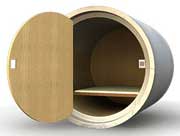
"Das ParkHotel offers room with minimum space volume for maximum comfort in the green heart of Linz. The reservoir under and beside the couch surface (fitted with an Optimo matress) offers some space for your luggage. There's even a power connection (220 V) for your electrical appliances and a plug for Internet connection.
Sanitary facilities, breakfast area and other hotel amenities are to be found around the hotel: at the Danube park public toilets and at the cafés of Linz city centre.
Book now and pay as you wish (apparently the system works quite well, people leave between 7 and 20 € and sometimes even little presents.)"
ViaWe-make-money-not-art
Arquitectura em 3D
Em 3D Spatial Models of Great Buildings podemos encontrar vários edifícios de arquitectos famosos em 3D. Para quem estuda ou aprecia a arquitectura...
Current TV
Já aqui tinha reportado um projecto do Channel4 chamado FourDocs. O CurrentTV Studio, é um projecto semelhante da estação de TV de Al Gore, ex-candidato à presidência dos EUA, onde as pessoas são livres de enviar pequenos filmes caseiros. Depois de serem aprovados pelos utilizadores do site, os filmes passam no canal de TV, que assegura a distribuição por cabo.
26.8.05
Como carregar baterias de telemóveis?

Para quem ainda não sabe, já existem no mercado carregadores de baterias de telemóveis que funcionam a energia solar! Nada mau!

... E o que dizer de um hamster que carrega baterias de telemóveis? :)
Foi o projecto de um jovem de 16 anos. Ele decidiu aproveitar que o hamster passava a noite toda a correr, e aproveitou essa energia! Ainda Melhor!
Via: Boing Boing
O futuro das Agro-urbes
Jack Schultz é um especialista em desenvolvimento imobiliário e autor de Boomtown USA um livro que aponta as pequenas cidades americanas como as que mais cresceram nos últimos meses. O aumento da ligações de banda-larga e wireless, as companhias aéreas low-cost e comboios de alta velocidade têm permitido a fixação de pessoas em pequenas cidades do interior.
Este estudo aponta para uma nova revolução e uma nova vaga de migração depois do advento da classe criativa proclamada por Richard Florida. Schultz em declarações ao jornal Expresso afrimava que as pessoas procuram qualidade de vida nas comunidades rurais e acabar com o stress do movimento diário entre as cidades e os subúrbios. "A pequenez deixou de contar. A questão da massa crítica urbana já não é tão importante como há 20 anos".
Em Portugal, com o seu atraso normal, ainda esperamos pela revolução, a sério, da classe criativa... Mas surgem cidades do interior de Portugal com forte ligação às Universidades, como a Covilhã, Braga ou Évora, que podem vir a ganhar alguma importância nas próximas décadas, num plano nacional e ibérico.
Link:Boomtown USA
Usabilidade em pequenos ecrãs
Location-Based Mobile Media

A àrea está em crescimento rápido, e quem melhor do que os americanos para criar já um curso!? Chama-se Location-Based Mobile Media: Maps, Games and Stories
e é leccionado no USC Interactive Media Division.
Via: Pasta and Vinegar

24.8.05
Electronic Arts muda-se para Genebra
Segundo a imprensa suiça, a líder mundial de jogos video, Electronic Arts, prepara-se para mudar os seus escritórios que incluem R&D, de Londres para Genebra! O que é que Genebra tem, que Lisboa não tem!? :)
"It's in the game!"
Artigo
Via Pasta and Vinegar
"It's in the game!"
Artigo
Via Pasta and Vinegar
23.8.05
WebOS ou Internet Ubíqua
Os pioneiros dos interfaces gráficos (GUI) como a IBM e a Apple, começaram por desenvolver esses sistemas como forma de criar uma "membrana" opaca para o utilizador. Quer isto dizer que um utilizador já não precisava de ser programador para puder interagir com o computador.
Jason Kottke apresenta-nos, em GoogleOS? YahooOS? MozillaOS? WebOS? um texto muito interessante sobre o que poderá ser o futuro próximo dos sistemas operativos. Aquilo a que Jason decidiu chamar WebOS. Dois acontecimentos recentes foram o suficiente para o motivar a escrever este artigo "Two recent events, Yahoo's purchase of Konfabulator and Google's release of a new beta version of Google Desktop have finally spurred me into action"
Utilizando a metáfora da "membrana opaca" a que me referi acima, a ideia de Kottke é a de que o WebOS irá permitir uma opacidade para o computador terminal, ou o disco local se quiserem, bem como para a web, sem que o utilizador se aperceba da passagem de conteúdos de um para o outro e entre aplicações online e offline.
"For application developers, the main advantage is that instead of writing two or more programs for multiple platforms (one for the Web, one for Windows, etc.), they can write one app that will run on any machine with the WebOS using the same code base"
Em termos de tecnologia, esta já está aí a ser utilizada, sem no entanto estar a ser explorada em todas as suas potencialidades. Chama-se Ajax e permite um novo tipo de relação Server-side vs Client-side. Em Ajax: A New Approach to Web Applications Jesse James Garrett, explica-nos de forma sucinta como funciona:

----------------------------------------------------------------------------

Vem isto no seguimento de alguns post anteriores ("The future of the web is not the browser") onde pegando na ideia dos feeds de RSS, eu lancei um pouco a ideia de uma Internet cada vez mais ubíqua, em que a mesma está presente no nosso dia-a-dia sem que nos apercebamos. Neste post anterior o autor do artigo sobre o qual me apoiava, afirmava que o futuro da web não era o browser, pelos vistos é um sistema operativo completo, segundo Kottke. Obviamente sobram posteriormente problemas para resolver de privacidade e controlo dos indivíduos...
Artigos:
GoogleOS? YahooOS? MozillaOS? WebOS?
Ajax: A New Approach to Web Applications
Jason Kottke apresenta-nos, em GoogleOS? YahooOS? MozillaOS? WebOS? um texto muito interessante sobre o que poderá ser o futuro próximo dos sistemas operativos. Aquilo a que Jason decidiu chamar WebOS. Dois acontecimentos recentes foram o suficiente para o motivar a escrever este artigo "Two recent events, Yahoo's purchase of Konfabulator and Google's release of a new beta version of Google Desktop have finally spurred me into action"
Utilizando a metáfora da "membrana opaca" a que me referi acima, a ideia de Kottke é a de que o WebOS irá permitir uma opacidade para o computador terminal, ou o disco local se quiserem, bem como para a web, sem que o utilizador se aperceba da passagem de conteúdos de um para o outro e entre aplicações online e offline.
"For application developers, the main advantage is that instead of writing two or more programs for multiple platforms (one for the Web, one for Windows, etc.), they can write one app that will run on any machine with the WebOS using the same code base"
Em termos de tecnologia, esta já está aí a ser utilizada, sem no entanto estar a ser explorada em todas as suas potencialidades. Chama-se Ajax e permite um novo tipo de relação Server-side vs Client-side. Em Ajax: A New Approach to Web Applications Jesse James Garrett, explica-nos de forma sucinta como funciona:
----------------------------------------------------------------------------
Vem isto no seguimento de alguns post anteriores ("The future of the web is not the browser") onde pegando na ideia dos feeds de RSS, eu lancei um pouco a ideia de uma Internet cada vez mais ubíqua, em que a mesma está presente no nosso dia-a-dia sem que nos apercebamos. Neste post anterior o autor do artigo sobre o qual me apoiava, afirmava que o futuro da web não era o browser, pelos vistos é um sistema operativo completo, segundo Kottke. Obviamente sobram posteriormente problemas para resolver de privacidade e controlo dos indivíduos...
Artigos:
GoogleOS? YahooOS? MozillaOS? WebOS?
Ajax: A New Approach to Web Applications
22.8.05
Website numa unha!
Por vezes temos destas surpresas que só a Internet nos dá!
Este é o mais pequeno website do mundo com 18x18 pixeis! Acima de tudo é uma prova de grande paciência para quem o fez, até porque dá para jogar Pacman e outros jogos!...
Link
Este é o mais pequeno website do mundo com 18x18 pixeis! Acima de tudo é uma prova de grande paciência para quem o fez, até porque dá para jogar Pacman e outros jogos!...
Link
Bluetooth Ad

Apesar de alguma polémica quanto à privacidade de utilizadores, a tecnologia Bluetooth já está a ser utilizada para a disseminação de mensagens publicitárias. Neste caso são os lounging spaces da Virgin Airways no aeroporto de Heathrow.
ViaMIT Advertising Lab
20.8.05
Nova arquitectura

"The Cardboard House represents the reduction of technology and the simplification of needs. By demonstrating that we are able to recycle 100% of the building components at extremely low cost, the Cardboard House is a direct challenge to the housing industry to reduce housing and environmental costs."

"These "Micro-Compact Homes" were designed at the Technical University of Munich and the Tokyo Institute of Technoloogy, inspired by the highly designed compact spaces in first-class airplane cabins and Smart cars. They are lightweight, transportable, and cost a mere 50,000 Euros. They're going to be installed in a "village" on campus at the Technical University of Munich."
Cardboard house
Micro compact home
18.8.05
Outro interface "Minority Report"

Sobre interfaces inspirados no filme de Spielberg, já alguém me perguntou se não serão muito cansativos para o utilizador, uma vez que os seus braços estão constantemente no ar?... A pergunta faz sentido, no entanto continuam a surgir soluções semelhantes.
Artigo
"The future of the web is not the browser"
No seguimento da ideia de Internet (cada vez mais) ubíqua de que tenho vindo a falar, a ideia deste autor segue um pouco o meu raciocínio em relação ao futuro da web. Os browsers serão cada vez mais dispensados, eu próprio passo cada vez menos tempo no browser, uma vez que recebo feeds de notícias por RSS, é claro que o Zé Pedro já está a pensar: "mas eu gosto de andar a navegar pela web à procura de ser surpreendido com coisas novas!" :).
Ainda assim empresas continuam a desenvolver, e a lançar, browsers como o que aqui falei, em 3D, da NTT Software Corporation. Vamos ver quem tem razão, num futuro próximo!
"... I get more and more the feeling that the future of the web sits not inside the browser window. (...) I am not talking about flishy flushy flash sites I am talking about proper use of this information and using them in a manner that presents the information so its easier and faster to understand and comprehend. (...) Pictures and user definable RSS streams are mixed to give an outsider an overview (...). I am not saying its anything new I just come to the conclusion that this is where part of the web is headed and I really like this."
Artigo
Mundos persistentes
No futuro os jogos com mundos persistentes irão alterar - já alteram - profundamente as sociedades. Mas não vale a pena ter uma visão apocalíptica do cenário, em A World of Warcraft World - 10 ways MMORPGs will change the future, podemos sorrir um pouco com o nosso futuro como jogadores... :)

"1. Everyone will look like a Greek god or goddess.
2. All will play in the same virtual world.
3. Someone will go to jail for stealing a Bonebiter.
4. You'll meet someone who plays an MMORPG for a living.
5. They'll take the "G" out of "MMORPG."
6. You will find yourself momentarily forgetting whether you're in the real or virtual world.
7. You'll meet a couple who have been married for years and have never seen each other's real-life faces.
8. There will be a branch of government to rule the virtual world.
9. There will be a whole class of wealthy people without a dime to their name.
10. The rise of the metaverse will go almost completely unopposed."
A massively (or massive) multiplayer online role-playing game or MMORPG is a multiplayer computer role-playing game that enables thousands of players to play in an evolving virtual world at the same time over the Internet. MMORPGs are a specific type of massively multiplayer online game (MMOG).
fonte: Wikipedia
Browser 3D

"a new 3D browser developed by NTT Software Corporation in which website pages are positioned in three-dimensional virtual space, so that the surfing experience is 'as natural as possible & the navigation through the structure of the website is improved' (sounds quite 1990s & VRML-like to me). its development is aimed at companies that want to show content on certain points or key areas."
Via information aesthetics
15.8.05
Escrever em PDA's
Dois investigadores da IBM, criaram um software que facilita a escrita em aparelhos móveis. Este software utiliza esquemas geométricos para cada palavra, e funciona com um teclado QWERTY ou ATOMIK. Com este software foi possível atingir velocidades de 60 a 70 palavras por minuto, menos do que num teclado normal, mas mais rápido do que escrever com as habituais canetas dos PDA's actuais.
"...the IBM team came up with software that works by using geometrical patterns to represent words."
"Instead of tapping out letters or writing a word on screen, you trace each letter in a single, fluid stroke. The keyboard on screen shows the shape of the word."
"The software works with a standard Qwerty keyboard, as well as IBM's experimental Atomik keyboard. The keys in the Atomik keyboard are arranged to maximise letter associations."

Artigo
"...the IBM team came up with software that works by using geometrical patterns to represent words."
"Instead of tapping out letters or writing a word on screen, you trace each letter in a single, fluid stroke. The keyboard on screen shows the shape of the word."
"The software works with a standard Qwerty keyboard, as well as IBM's experimental Atomik keyboard. The keys in the Atomik keyboard are arranged to maximise letter associations."
Artigo
14.8.05
Wikipedia ao serviço do Marketing
O Wikipedia tem sido manipulado em favor de interesses comerciais. Um anónimo assume isso mesmo, depois de BoingBoing ter denunciado num artigo a mesma prática por parte da BBC.
"I can't say who I am, but I do work at a company that uses Wikipedia as a key part of online marketing strategies. That includes planting of viral information in entries, modification of entries to point to new promotional sites or "leaks" embedded in entries to test diffusion of information. Wikipedia is just a more transparent version of Myspace as far as some companies are concerned. We love it (evil laugh)."
Artigo
Busca!... milhões
Num artigo de Spencer Kelly, na BBC News é possível ler um resumo do estado de evolução dos portais e motores de busca online. A guerra situa-se antes de mais em tentar conquistar os utilizadores como a primeira página de entrada quando estes abrem o browser.
"Naturally, search in general will always be a big web application, and after Google's enormous success it seems that everyone now agrees that a clean and simple search interface is a good thing.
First came the MSN no-frills Search, and now we have Yahoo's new-look search, which has unashamedly been Googled."
A "googlização" das páginas de busca, com um interface limpo tem sido um dos sinais mais visíveis da competição entre MSN, Yahoo, AskJeeves e outros. Mas o próximo passo é tentar oferecer a cada utilizador capacidades de personalização de conteúdos e interface da sua página de entrada na web, tornando-os disponiveis em todos os pontos em que um mesmo utilizador possa aceder à Internet. Esta capacidade faz-me lembrar a computação ubíqua, sendo que neste caso seria a Internet ubíqua.
"But the key to winning our favour may not be just a nice empty search window with lots of empty space."
(...)
"The important thing might be that we can take those features with us."
(...)
"All these facilities are free to us, so the web big guys will have to make their money elsewhere, namely advertising"
13.8.05
América profunda
Via BoingBoing, encontrei este video.
Inclassificável no âmbito deste blog, mas porque estamos na silly season não podia deixar de destacar esta obra prima da cultura americana. :)
Link
Inclassificável no âmbito deste blog, mas porque estamos na silly season não podia deixar de destacar esta obra prima da cultura americana. :)
Link
12.8.05
Split Screen

O Split Screen em cinema e televisão é uma técnica utilizada há muito no meio audiovisual. Agora tem direito a um BLOG! :)
Estou-me a lembrar de Ocean's Eleven de Steven Soderbergh que também utilizava esta técnica, num estilo visual retro das décadas de 50/60.
BD em colaboração
Uma experiência muito interessante que explora o trabalho em colaboração que a Internet oferece. Panel Junction é uma BD que nasce da colaboração de vários autores e que no fim disponibiliza o documento pronto para impressão em formato PDF:
"Panel Junction combines the graphic novel with forms of shared authorship that have been made possible by the Internet. Contributions from visitors to this site will culminate in a free document suitable for printing with an ink-jet printer."
Panel Junction é um exercício interessante que nos mostra a importância do trabalho em colaboração na Internet. No futuro tarefas de cariz intelectual serão desenvolvidas cada vez mais, em conjunto. É caso para dizer que duas cabeças pensam melhor que uma!
8.8.05
Yahoo Audio Search
Esta ainda é uma versão BETA, mas pode vir a ser um serviço muito popular.
O audio search faz uma busca de ficheiros áudio por sites como o Napster, o iTunes ou Rhapsody, para além de podcasts.
http://audio.search.yahoo.com/
O audio search faz uma busca de ficheiros áudio por sites como o Napster, o iTunes ou Rhapsody, para além de podcasts.
http://audio.search.yahoo.com/
Subscrever:
Mensagens (Atom)